Inquiry
Form loading...

Top 10 Fulldome Projection Manufacturers in China

China’s fulldome projection market brings together optical engineering, media servers, dome screens, and on-site integration. This guide introduces ten manufacturers serving museums, planetariums, science centers, and immersive venues. It is a starting point, not a definitive ranking: product lines and regional support can change quickly.

Immersive-media researcher Paul Bourke’s published work points to a practical principle: treat dome geometry, projector placement, and image warping as one system. That matters when a bright image still shows a visible seam near the horizon. Buyers should compare native resolution, calibrated brightness, edge-blending quality, color consistency, and maintenance access. Ask for a demonstration using content similar to your own, not only a polished showroom reel. Check who handles installation, calibration, spare parts, and staff training. These details often separate a workable system from a dependable one.

There are trade-offs. A lower-cost package may suit a compact venue, yet require more hands-on calibration. A premium specification may look impressive, but still exceed the room’s actual needs. Vendor claims deserve careful checking against project references and measurable test results. Some public specifications are incomplete; that is worth noting, not glossing over. The manufacturers profiled here are therefore best compared by application, integration experience, and after-sales capability—not by headline brightness alone. A dome is unforgiving. Small alignment errors show.
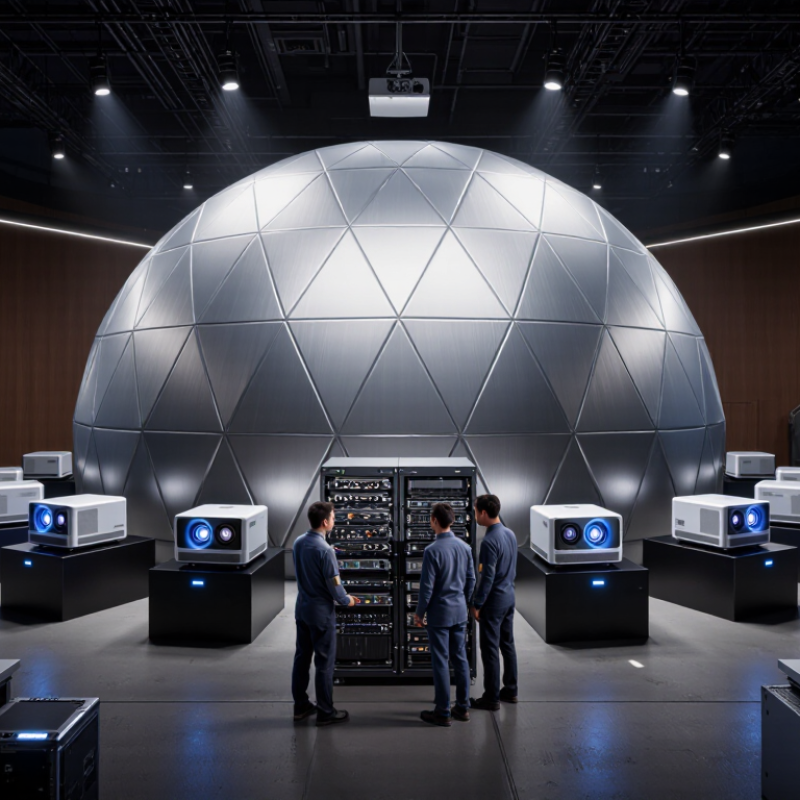
Top 10 Fulldome Projection Manufacturers in China

Fulldome Projection Technology and Its Core Components

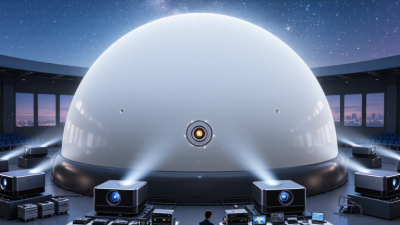
Fulldome projection depends on more than bright projectors. A complete system combines projection engines, fisheye lenses, a media server, synchronization hardware, and a carefully prepared dome surface. Each lens spreads an image across a curved screen, while edge blending hides overlap between projectors. Calibration then aligns stars, captions, and moving objects across the dome. Small alignment errors become obvious overhead.

AVIXA’s 2024 Industry Outlook and Trends Analysis projected global professional audiovisual revenue at about US$325 billion in 2024, rising to US$402 billion by 2029. This broad market forecast is not specific to fulldome systems, but it shows the scale of the wider technical field. For dome operators, resolution alone is a weak buying measure. Brightness uniformity, color matching, frame synchronization, and service access matter too. Seamless blending is never guaranteed.

Tips: Test with dark scenes and fine star fields, not only bright demo footage. Measure brightness at several dome positions, then check again after warm-up. Record lens settings and calibration values. A practical flaw remains: even well-calibrated systems may show seams when projectors age at different rates.

Pixel Count of Common Projection Resolution Formats

A comparison of standard image resolutions relevant to fulldome projection workflows. Pixel counts are calculated from each format’s horizontal and vertical dimensions.

UHD 4K contains 8.29 megapixels, DCI 4K contains 8.85 megapixels, and UHD 8K contains 33.18 megapixels. Resolution alone does not determine perceived dome image quality; projection optics, image warping, blending, and viewing conditions also matter.

Criteria for Evaluating Chinese Fulldome Projection Manufacturers

Evaluating Chinese fulldome projection manufacturers requires more than comparing projector brightness or quoted resolution. Ask how the system handles dome geometry, edge blending, and color uniformity across the entire surface. Request measured results, not just catalog figures. A practical demonstration should include a star field, fine text, and a moving scene. Look for seams near the horizon and dim patches overhead. Small defects become obvious in a dark room.

Check the calibration process, lens selection, control software, and replacement-part availability. Ask for installation drawings, power and cooling requirements, and written service response times. A capable supplier should explain trade-offs plainly, including where its system performs less well. No checklist catches everything. Ideally, review a test in a dome similar in diameter and seating layout to yours; a flat-screen demonstration proves little. Compare operating noise and image stability after several hours, not only at startup. Also confirm whether staff training and updated documentation are included. Specifications can flatter a system, while real venues behave less neatly. I would leave room for judgment and record unanswered questions before committing.

Top 10 Fulldome Projection Manufacturers in China — Criteria for Evaluating Chinese Fulldome Projection Manufacturers

The criteria and weights below are a suggested procurement scorecard, not verified rankings or performance claims about specific manufacturers. Confirm specifications, references, and service commitments directly with each supplier.

No. Evaluation criterion Suggested weight What to assess Evidence to request
1 Projection system design 15% Suitability of projector type, projector count, lens configuration, and system layout for the dome’s diameter, seating, and intended use. Projector and lens specifications, system layout, and a site-specific design proposal.
2 Image resolution and coverage 13% Effective image detail across the dome, including edge coverage, pixel distribution, and suitability for the planned content. Rendered resolution map, test patterns, and a demonstration using representative fulldome content.
3 Brightness and uniformity 12% Usable brightness at the dome surface and consistency across the image, assessed under the proposed operating conditions. Measured brightness results, measurement method, and uniformity test images from a comparable installation.
4 Warping and edge blending 12% Geometric alignment and visibility of transitions between overlapping projector images across the dome. Live calibration demonstration, blended test patterns, and details of manual and automatic adjustment tools.
5 Dome screen compatibility 8% Compatibility with the screen’s geometry, surface, gain, perforation, and viewing environment. Screen recommendations, compatibility requirements, and a documented installation or test plan.
6 Playback and content workflow 10% Support for the customer’s required fulldome formats, playback workflow, show control, and content management needs. Supported-format list, sample playback, and written confirmation of required third-party integrations.
7 System integration and controls 8% Integration with audio, lighting, show-control systems, room equipment, and the venue’s network or operational requirements. Interface list, control-system diagram, and a responsibility matrix for equipment and integration work.
8 Installation and calibration 8% Clarity of site preparation, installation, commissioning, calibration, staff training, and handover arrangements. Project schedule, scope of work, commissioning checklist, and training plan.
9 Reliability, warranty, and service 8% Documented warranty scope, parts availability, response process, remote support, and service coverage for the installation location. Written warranty terms, service-level commitments, spare-parts policy, and support escalation procedure.
10 Relevant experience and total cost 6% Experience with comparable dome projects and clarity of total project costs, including installation, software, training, and ongoing service. Verifiable project references, itemized quotation, exclusions, payment milestones, and recurring-cost schedule.
Total suggested weighting 100% Score each supplier against the same project requirements and evidence standard.

Top 10 Fulldome Projection Manufacturers in China

China’s fulldome projection manufacturers serve planetariums, science centers, museums, and immersive venues. A useful top-ten comparison should look beyond advertised brightness. Check native resolution, edge blending, color consistency, cooling design, and compatibility with dome geometry. Small differences become obvious across a curved screen. Details matter.

Ask each manufacturer for a projection layout based on your dome’s diameter, seating, and ambient light. Request a live demonstration or unedited sample footage, then inspect dark scenes, star fields, and fine text. Confirm installation support, calibration tools, spare-part availability, and realistic delivery schedules. A clear warranty is useful, but response time matters too. Test it live.

No single ranking suits every venue. Some manufacturers may focus on optical hardware, while others provide integrated control systems and installation services. Compare documented specifications with independent measurements where possible, and ask for references from projects of similar scale. One limitation: public product information can be incomplete, and demonstrations may not match a finished installation. Treat the top ten as a shortlist, not a guarantee. A site visit, detailed technical review, and careful assessment of long-term maintenance can reveal issues a brochure misses.

Company Profiles: Products, Applications, and Market Presence

Company profiles should explain what each manufacturer actually builds: full-dome projectors, multi-projector systems, playback servers, or installation support. Buyers need practical details, not broad claims. Look for brightness, resolution, edge-blending capability, and dome size. A clear product list helps schools, science centers, and mobile planetariums compare systems against room conditions and budgets.

Applications reveal a manufacturer’s experience. A system designed for astronomy shows different strengths from one used for immersive education or cultural shows. Ask whether the company provides calibration, content testing, and local technical support. Small details count. A bright projector can still produce uneven images if alignment and dome geometry are poorly managed.

Market presence also deserves careful reading. MarketsandMarkets’ Projection Mapping Market report (2023) projected growth from 3.3 billion US dollars in 2023 to 8.4 billion by 2028. This broader category is not a measure of fulldome equipment sales, but it signals rising interest in immersive projection. I would still verify each supplier’s service coverage and installation record; product claims alone are not enough.

Applications and Trends in China's Fulldome Projection Industry

China’s fulldome projection systems serve planetariums, science museums, schools, and cultural tourism venues. In a planetarium, a carefully aligned star field can make a classroom lesson feel immediate. Museums also use dome shows to explain weather, oceans, and space science. Some venues add interactive content, letting visitors influence what appears overhead.

A clear trend is the move toward brighter, higher-resolution projection and more flexible digital content. Laser light sources can support vivid images during frequent public screenings, while real-time rendering helps create responsive experiences. But impressive visuals depend on practical details. Projectors need precise alignment, reliable cooling, and regular color calibration. Even a small mismatch can turn a smooth horizon into a distracting seam.

Operators are also seeking content that works for local audiences, including Chinese-language educational programs and regionally relevant cultural themes. This creates opportunities for domestic production and technical integration. Still, not every venue needs the most complex system. Smaller museums may face tight budgets, limited staff, and demanding maintenance schedules. Those constraints are easy to underestimate. A simpler installation may serve visitors better, though this judgment can change as attendance and programming grow.