Choosing among Star Observatories is not simply a search for the largest telescope or the highest mountain. The right destination depends on what you hope to see, when you can travel, and how much guidance you need. A remote site may offer darker skies, yet thin air, cold nights, and limited transport can make a visit demanding. Details matter.
Compare local weather records, light pollution, elevation, seasonal visibility, and access to public observing sessions. Check whether the facility welcomes visitors, requires reservations, or offers only scheduled tours. A planetarium show can be informative, but it is not the same as viewing Saturn through an eyepiece.
For a sound comparison, read official visitor guidance and verify dates, equipment access, accessibility, and cancellation policies before booking. Look for named instruments, trained staff, and clear explanations of viewing conditions rather than promises of spectacular sights. Clouds happen. A credible site will explain what visitors can realistically expect and what happens when weather blocks the view. If possible, compare astronomy-club reports with current facility information; older reviews may describe outdated programs or equipment. Also consider whether you prefer guided learning, quiet personal observing, or research-focused exhibits. There is no universal winner. Careful planning cannot guarantee clear skies, and a famous name alone does not promise the best experience. Choose a place whose strengths match your priorities, while leaving room for surprise—and occasional disappointment.
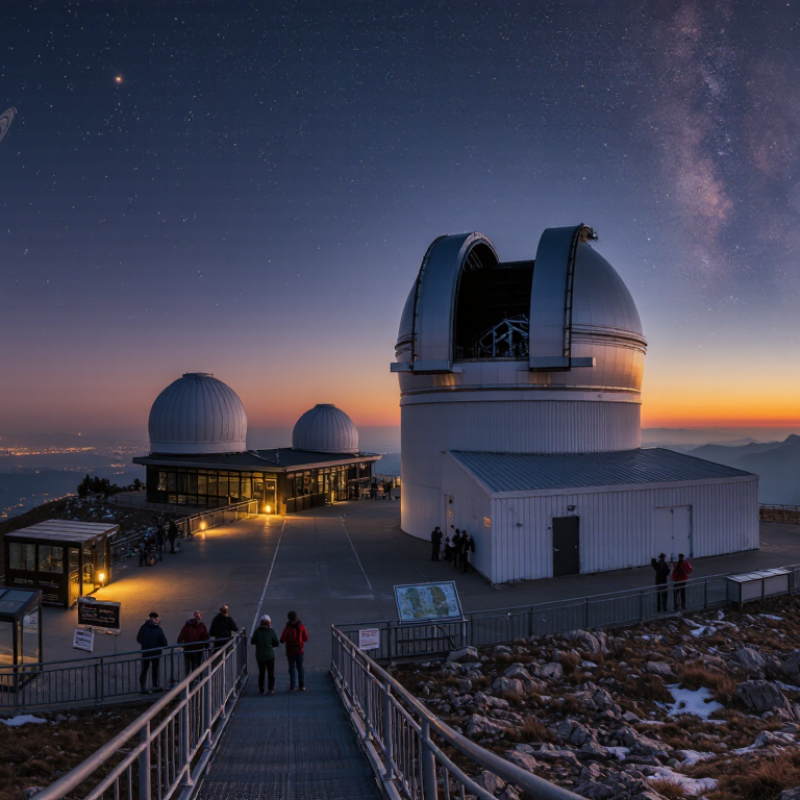
An observatory is more than a telescope; its instruments determine what the sky can reveal. Optical observatories collect visible light, making them useful for planets, stars, galaxies, and changes in brightness. Radio observatories detect long-wavelength signals, including emission from cold gas and energetic cosmic processes. Infrared facilities can study cooler objects and dust-hidden regions, though Earth’s atmosphere blocks some infrared bands. Solar observatories use specialized filters and instruments to track sunspots, flares, and surface motion. That matters.
Match the wavelength to a clear question. For sharp views of the Moon or bright planets, consider optical access, steady air, and local light pollution. To investigate molecular clouds or pulsars, look for radio capability and suitable data access. For star-forming regions obscured by dust, infrared coverage may be more useful than a darker optical site. If your goal is observing the Sun, choose properly filtered solar equipment and follow trained staff guidance. A space observatory avoids atmospheric interference, but scheduling and public data policies can limit access.
Compare more than aperture or elevation. Check wavelength range, detector sensitivity, weather records, observing hours, and whether visitors can use the instruments. A large telescope cannot compensate for a wavelength that does not answer your question. Revisit your goal after checking sample images or archived observations; expectations are often too broad at first. No observatory is perfect. Clouds, maintenance, and queue times can disrupt a sensible choice, so keep a practical backup plan.
How to Choose the Best Star Observatories?
Measure Sky Darkness: Pristine Sites Can Exceed 21.5 mag/arcsec²
A dark-sky reading is a practical starting point when comparing observatory sites. On a moonless, cloud-free night, a calibrated sky-quality meter can measure brightness in magnitudes per square arcsecond. Higher readings mean darker skies; a value above 21.5 often indicates excellent conditions. Still, one reading is not a verdict. Moonlight, haze, and nearby lighting can shift results, so compare repeated measurements taken at consistent times.
The scale is logarithmic: a one-magnitude difference represents about 2.512 times the sky brightness. That makes small-looking changes meaningful. A site near 21.7 can reveal faint structure in the Milky Way, while a brighter background may wash out delicate detail. Give your eyes time to adapt, then check whether the horizon glows above distant towns. Numbers can mislead.
For context, Falchi and colleagues’ 2016 World Atlas of Artificial Night Sky Brightness, published in Science Advances, estimated that more than 80% of the world’s population experiences light-polluted skies. It also found the Milky Way is hidden from over one-third of humanity. When assessing a candidate location, pair meter readings with weather records and repeat observations across seasons. The evidence may be imperfect; that is exactly why a single exceptionally dark night should not decide the site.
A star observatory’s “seeing” describes how Earth’s atmosphere blurs a point of light. It is measured in arcseconds: smaller values generally mean sharper images. European Southern Observatory site-characterisation data report a median seeing of about 0.8″ at Paranal. In practical terms, a star’s image typically spreads across a patch about 0.8 arcseconds wide under the stated measurement conditions.
A useful baseline. The figure is a median, not a promise for every night.
When comparing sites, check how and when the measurements were made. Wavelength, telescope altitude, exposure time, and the instrument used can affect reported seeing. ESO’s Paranal site-monitoring records use atmospheric measurements to track conditions over time; those records are more informative than a single night’s observation. Still, a clean number can mislead. A site with a strong median may have occasional turbulent hours, while a slightly weaker median could offer steadier conditions. For a planned visit or observing project, look for long-term distributions and seasonal patterns, not just the headline value. Ask whether the quoted 0.8″ applies at zenith and at a specified wavelength. Small details matter.
Maunakea’s summit rises to about 4,205 m, or roughly 13,800 feet. The U.S. Geological Survey lists the summit at 13,803 feet. That height places observatories above much of the atmosphere’s moisture and turbulence. For astronomers, drier air can improve observations, especially at infrared wavelengths. The trade-off is real: thin air, cold nights, and wind make summit work physically demanding.
Elevation alone does not guarantee clear skies. Schöck and colleagues’ 2009 site-testing study, published in Publications of the Astronomical Society of the Pacific, measured median astronomical seeing near 0.5 arcsecond at Maunakea. Seeing describes how atmospheric turbulence blurs a star’s image. Small details matter. A sharp-looking night can still be interrupted by clouds or changing wind, so observatories need dependable weather monitoring and flexible observing schedules.
When comparing sites, consider usable observing hours, not just altitude. Check long-term cloud, wind, humidity, and seeing records from professional site-testing programs. Also ask how often conditions prevent safe summit access; the answer affects maintenance and staffing, not only telescope performance. These comparisons are imperfect, because measurements come from different instruments and periods. Even so, Maunakea’s elevation and documented seeing make it a strong reference point—not a promise of clear skies every night.
Choosing a star observatory means checking what visitors can actually use, not just the telescope’s size. Ask whether public sessions include guided viewing and whether staff explain the instruments. A large telescope may be reserved for research, while visitors use smaller scopes outside. That distinction matters. Check opening hours, advance booking, weather cancellations, and whether cloudy-night alternatives are offered. Also confirm accessibility, age guidance, photography rules, and how long you can observe.
Location and lighting matter, too. Falchi and colleagues’ 2016 global atlas, published in Science Advances, estimated that more than 80% of the world’s population lives under light-polluted skies. Ask whether viewing takes place outdoors, away from bright paths, and whether red lights are used to preserve night vision. A specification sheet can feel convincing, but it cannot promise clear skies. I would compare the visitor experience, not assume that higher magnification guarantees a better view.
Tips: Email ahead with one specific question: “Which telescope will visitors look through tonight?” Bring a warm layer, even in mild weather. Small details matter. If the answer about instruments or cancellations is vague, consider another site.
| Observatory | Location and setting | Public telescope access | Notable instruments or facilities | Visitor policies to check | Best suited for |
|---|---|---|---|---|---|
| Griffith Observatory | Los Angeles, California; urban hilltop setting with views across the city. | Public telescope viewing is offered when the telescopes are open and weather permits. | Public observing includes a 12-inch Zeiss refracting telescope and solar telescopes; the building also has astronomy exhibits and a planetarium. | Admission to the building is free; planetarium shows have separate tickets. Check opening hours, viewing availability, and parking or transit options. | First-time visitors, families, and travelers who want exhibits and public viewing without a dark-sky trip. |
| Lowell Observatory | Flagstaff, Arizona; a high-elevation site within a designated dark-sky region. | Visitors can attend scheduled daytime and evening programs; telescope viewing depends on the program, weather, and operating conditions. | The historic 24-inch Clark refractor is a prominent visitor attraction, alongside other observing facilities and astronomy exhibits. | General admission and some events require tickets. Review the daily schedule, evening-program availability, and any reservation requirements before visiting. | Visitors seeking a blend of astronomy history, guided interpretation, and scheduled observing. |
| Kitt Peak National Observatory | Tohono O’odham Nation, Arizona; a remote mountain site at roughly 6,900 feet (2,100 meters). | Public access is through designated visitor activities; research telescopes are not generally available for independent visitor use. | The site hosts a collection of professional optical and radio telescopes, including the 4-meter Mayall Telescope; public programs use designated visitor facilities. | Tours and observing programs may require advance reservations and can be affected by weather, road conditions, or operational changes. Confirm access arrangements before traveling. | Visitors interested in professional observatory facilities and guided, reservation-based programs. |
| Mount Wilson Observatory | San Gabriel Mountains, California; a historic mountain observatory above the Los Angeles basin. | Public access is typically through scheduled tours and special observing events rather than unrestricted entry. | The site is known for its 60-inch and 100-inch telescopes; visitor access to telescope interiors or observing sessions depends on the event. | Check event dates, tour availability, road access, and reservation rules. Some areas or activities may be unavailable on particular days. | History-minded visitors and astronomy enthusiasts willing to plan around scheduled tours. |
| Mauna Kea Visitor Information Station | Hawaiʻi Island, Hawaiʻi; the visitor station is at about 9,200 feet (2,800 meters), below the summit observatories. | The visitor station offers visitor information and may host stargazing activities; summit research facilities are not general-purpose public viewing sites. | The summit contains multiple professional observatories and telescopes operated by separate organizations; access to those instruments is restricted. | Check current station hours, program availability, weather, road conditions, and altitude guidance. Visitors should follow local access rules and avoid assuming summit entry is permitted. | Travelers seeking a high-altitude setting and night-sky information while respecting access and altitude considerations. |
| Visitor schedules, telescope availability, fees, and access rules can change. Confirm details with the observatory before making travel plans; clear skies do not guarantee that a telescope will be available for public viewing. | |||||